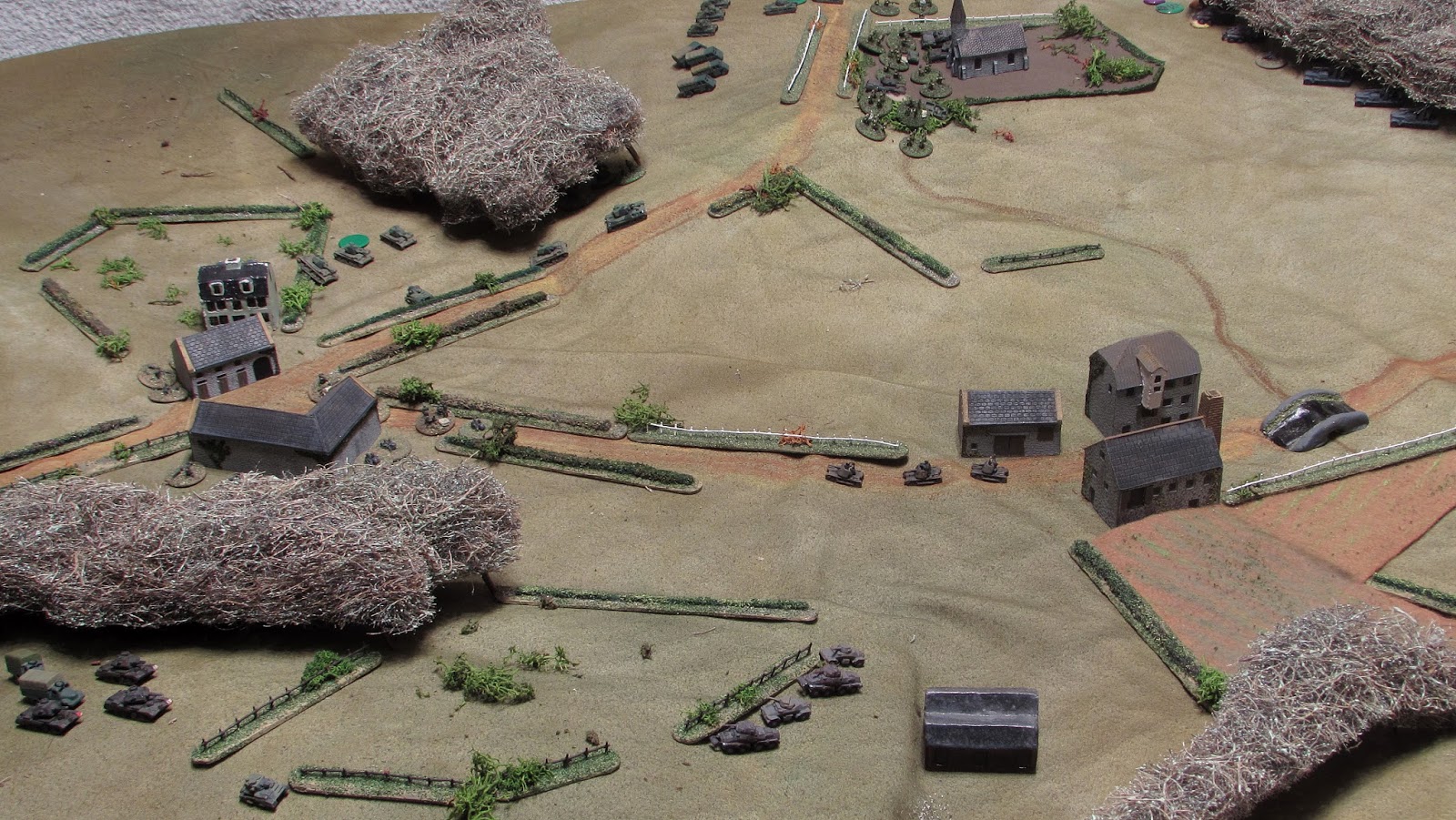
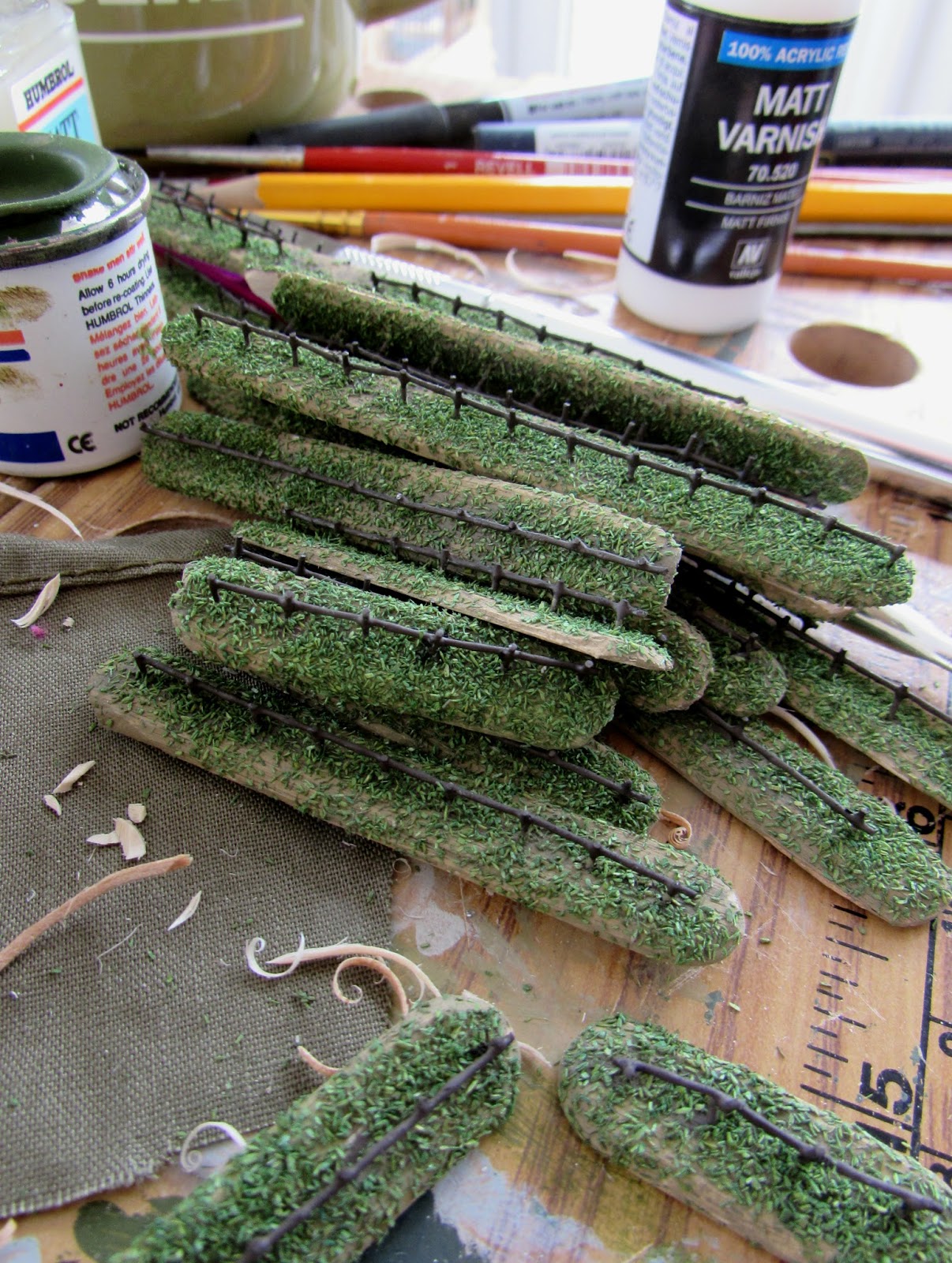
Monday, 2 May 2016

Vallée des Champs, 1: L'Ouverture

Hill forms used
I had done some more French tank camouflage so felt I deserved another game although of course I have loads more painting to do.


Terrained-up
There was a crease right down the middle of the cloth so I put a road there to disguise it. I rolled a dice for the direction of one road and the third I wanted to send down a cutting between hills and up onto some high ground. It had to turn to lessen the gradient and to explain why the road went that way, I put a farm there. Two of the woods were placed by my daughter.


Rolling for units, I used a full list of everything I've got. Thrillingly, StuGs were first, then Kradschutzen, SiG33s and Panzer 38(t)s. For the Allies, I got motorised infantry, a battery of 75mm, some MkVI light tanks and some foot infantry. That was going to be a bit too imbalanced so I rolled a scout car platoon, 25m AT guns, 3" mortars and a few Char Bs as well. With the gun-heavy Allied makeup I thought I'd let them defend but with the 3" mortars and motorised infantry as reinforcements and upgraded the foot infantry to cycle infantry (not that they did much cycling, it turns out).

Dispositions & Orders

The Allies were basically defending (although when I set them up, the only thing that was known was the German 'spawn point'). The escorted SPG column was found to be travelling more or less diagonally across the board to the high ground.

Swarming down the slope
The unsuspecting Germans planned to pass  Belgian House behind the small wood, through Marsh Farm and up onto the hill. (I've since repainted & shortened the tree trunks! These are cocktail sticks inserted from underneath which are gripped by the rubberised horsehair and do not fall out when the tree canopy is lifted off)


I wanted to make a special effort to track the passing of orders in this game because playing solo I sometimes gloss over the exact timings and movements of orders. (So when a CO is activated and wants to issue an order, it is written on the unit's order list and a white counter placed by the recipient. At the start of the next turn, each order is diced for receiving and if successful, the written down order is ticked off for putting into action, building in a 1 turn delay which can go up levels of command for further lag)

Orders
Here we see the Allied commander attempting to pass a flurry of orders:
  • Char Bs & cycle infantry to advance
  • 75mm battery to lay a barrage down in the path of the German column
  • battery OP to advance to Belgian House
  • scout platoon to commence flanking movement
The English must have been 'having tea' because I had forgot to put them 'on alert' (what I call overwatch) and took an extra turn to 'range in'.

The Char Bs have quite a pretty camouflage scheme but they, along with most of my stuff hasn't had a wash or highlights yet. I'd obviously rather be playing games

Scouts leave Marsh Farm
The scout platoon leaves its start point. 

Belgian House in the distance is called that because...well, maybe it does look like a house in Belgium but that was just what the casting was called (possibly from Tabletop Games in Nottingham or a very early incarnation of Heroics & Ros from their building range). Bought from the same source was the "large house" at the foot of the picture and Red House near the British HQ. The barns and so on are Leven Miniatures.


Char Bs get their orders

In this instance it took 3 turns for the Char Bs to receive & understand the order to advance which was typical of the tank radio problems of the day (indeed, if radios were even present).

You can see the variation in figure basings for different units, so that they can pass among each other and not get jumbled up, or need eye-catching coloured markings. Different base paint colour and flock type is all it is, actually in this case the only units present are the cycle infantry and 25mm AT crews, however.

The MkVI light tanks pin down a couple of the Kradschützen and the 75mms lay down a somewhat ineffectual harrassing barrage on the distant road, their OP moving up for a better look.

The scout platoon continues its probe down the narrow track.

The light tanks cause some casualties among the Kradschützen, a 25mm takes out a Panzer 38(t) and the spotter (now in the house) directs the 75s onto the SPGs (these have 2-3 H&R standing guncrews with bases cut off in the fighting compartment).

I do not keep track of where the CO is in a tank formation: When there is a casualty, I dice to see if it was the CO. That way not I am unable to subconsciously and advantageously target the CO.

(The green counter by the Kradschützen shows there are 11 elements in the unit, the loss of each causes a drop of 9% to the score and the current score is 78%. The purple tiddlywink (to be replaced by 'scenic' markers at some point) means they are 'uneasy' and can only advance if into cover, which they are under orders to do anyway).
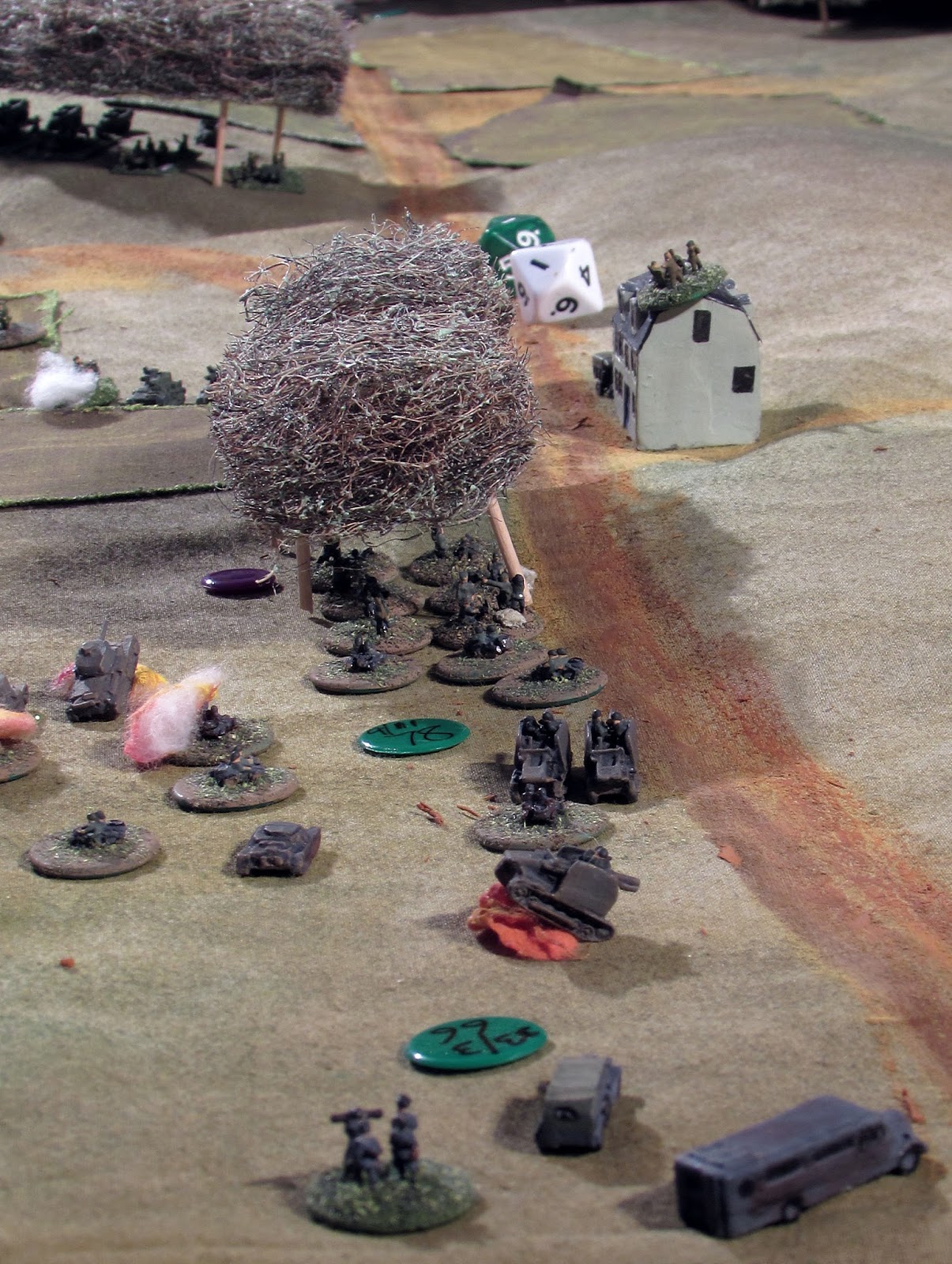
The SiGs turn to blast Belgian House, the probable location of any artillery spotters but they roll 71 & 72 when it was 70 to hit. The Munitionsschlepper SdKfz111 has to stay close as they only carried 3 rounds on board.

Yes, that might even be Rommel, as there are Panzer 38(t)s & SiG33s in the game, it could be the 7th Panzer Division! (Although I don't think they operated with any StuGs, that was the 8th Pz Div but they didn't have SiG33s...)

(Sorry about the dice in this picture!)

"Achtung!"


The scout cars make their move on the German HQ (who no doubt have that 'turning of the ignition key' movie closeup moment) and the Bren carriers & MkVIs nose up to the brow of the hill. (That's the scout platoon CO at the RVP with a boulder = leader on his base)

If the Panzer 38(t)s get the message (white counter) they will be able to react to the scout cars seen by 'Rommel', otherwise the plucky Brits will be in their blind spot, at least until they fire.

The distant StuGs fire smoke at the advancing impenetrable Char Bs; Belgian House is razed for the hell of it; French infantry plods forward over the fields; the Panzers turn to face the scout car rear attack but the wireless bus gets hosed by Bren fire.


At some point a 99 had been rolled in the game and a wildcard was drawn, the Ace of Spades, enabling the 75mm spotters to 'transport Star Trek style' over to the barn by the fields (possibly they had been heading there under their own initiative and only just informed HQ of their actions??). From here they called in a barrage onto the distant German HQ.

The scout platoon Bren carriers deploy on the brow of the hill, hoping to get a good AT rifle hit on the 150mm SPGs but the MkVIs stay hull down (brown counters).

The smokescreen grows, blinding the Char Bs.

The Germans now get a wildcard when 100 is rolled (a critical miss, if I had such a thing, by the Panzer 38s at the scout cars!) but they get a 'free 150mm barrage'. Maybe the StuG CO changed frequencies and got ahold of someone, who can say? Anyway, the ground erupted around the French leviathans, destroying the troop leader's tank.
Realizing they had gone further than orders really permitted, the scout cars turned back towards the RVP. One was picked off by the Panzers but another salvo from the 75s rained down on the hapless remainder of the HQ and decapitated the German Eagle.

End of game: 'Rommel' killed

I am going to either refight this game with the same terrain (less than a quarter of it got used) but with some hedges & fences wich I forgot to put on and not faff about with the German 'attack' quite as much (was the objective the far corner of the board on the high ground or was it to destroy enemy forces en route?) or I may have a follow up on the same battlefield consisting of a German 'reprisal' counter attack. 

Sunday, 24 April 2016

City Blocks, 2: windows & doors

It's a horrible job trying to paint windows & doors neatly on plain wooden blocks.

I reckoned the easiest way (other than a template) would be to stamp window reveals and door openings onto the wooden building shapes then I would have something a bit 3D.


Mk1
The Mk1 range of architectural stampers consisted of plasticard window shapes superglued onto an old flat bracket in a line so I could stamp one vertical column of windows in one go without having to do a lot of lining up. But it was all very well having them in the middle of a good bit of metal but it was impossible to see if they were in line. 

There was a Mk1A for full height windows for single storey buildings but this was quite hard to impress on the wood due to the pressures needed.

Mk2 & Mk1A
A square doorknob spindle (only 1mm wider than the window shapes) was used instead which meant you could easily see how the plasticard bits were lining up with the other windows.


Mk3

The Mk3 stamper had a bit of plasticard big enough to be a door glued onto another part of the spindle to extend any of the windows down to floor level.


If you hit too hard (I was using a club hammer but gently), the pine would splinter a bit as the window shape was pushed in and also you cannot stamp windows & doors where there are knots in the wood or on the ends of the grain as the wood is just too hard. Hopefully any splintering might be hideable at the painting stage or put some flock on it like ivy. By some fluke I got a regular window arrangement all down some of the city blocks but it was easier to do them in coumns of 2, 3, 4 or 5 and then convert some of the lower windows into doors.

(fairly) Regularly spaced, square windows & doors

Then I started using the slightly rounded end of the spindle to make arched doors which actually looked slightly better than square ones. I gave up on doing chimney stacks for the time being as cutting the plasticard was fiddly but I'll keep an eye out for any suitable scrap as the roofs look bit plain otherwise and I really did want a lot of chimnies running down the apex of the roofs.

Off for some tins of spray paint tomorrow...

Sedan, May 13th 1940, 1: Scenario Research

All my games have been 'typical' battles as the terrain tiles did not lend themselves to recreating anything but an approximate setting for a real engagement. Now that I've got a nice gaming cloth and a selection of land forms to put under it, I've been on the lookout for a suitable battle.

Colonel Goutard's "Battle Of France" and Alistair Horne's "To Lose A Battle" are my staple reads for overviews of the invasion of France. Together, I think they give me enough information on actions in the campaign to be able to produce recognisable “based on” simulations without referring to unit unit histories (none from the French seem to have survived the war and probably this is just as well).

Working my way through chronologically, one of the earlier actions that took my fancy was the crossing of the Meuse at Sedan on 13th May.


An excellent find was "The Blitzrieg Legend" by Karl-Heinz Frieser which added more detail to this scenario (and the rest of the French campaign) and a fine map from which it was possible to imagine the area as it was in 1940 without the modern waterpark on one side of town and industrial area on the other shown on Google Streetview. Apart from enabling the gamer to see the lay of the land more less first hand, Streetview was very useful for finding landmarks and points of interest in the town which I will try and have on the gaming table for local colour. For instance, the rail line towards Bazeilles (built over when the waterpark was created) and crossing-keepers cottage or small halt at the main road; the Chateau Bellevue on the way to Frénois; the large cemetery above town on the SS Regt Großdeutschland approach; and the pretty Église Notre Dame above Wadelincourt. All good features to help get into the scenario

Approach route for SS Großdeutschland

SS Großdeutschland crossing point

Site of level crossing towards Balan

Chateau Bellevue near Frénois

Église Notre Dame, Wadelincourt

The battle was predominantly an infantry affair, which I think will be an unusual basis for a wargame, there normally being a dearth of foot troops in Kursk-like "typical" battle tank swarmings. Crossings were attempted at six points in the area as seen on the map, notwithstanding all bridges were blown by the French:

  • Donchery 2nd Pz Div Panzer, Schutzen & Kradschutzen Rgts
  • Isle des Iges 1st Pz Div Kradschutzen Rgt
  • Gaulier 1st Pz Div Schutzen Rgt
  • Sedan NW 1st Pz Div Grossdeutschland Rgt
  • Sedan SE 10th Pz Div Schutzen Rgt
  • Wadelincourt           10th Pz Div Schutzen Rgt

The first and last of those listed were unable to cross the Meuse because of covering fire from bunkers and enemy artillery shelling respectively. The 1st Pz Kradschutzen, although managing to get onto the Isle des Iges, were prevented from crossing the canal between Glaire and Villette until the division's Schutzen cleared the overlooking bunkers here and at Donchery from the rear. The two Schutzen regiments crossed at and followed the NW & SE edges of the town and went on to secure Frenois, Wadelincourt, the Marfee Heights and Cheveuges.

Isle des Iges across the Meuse

Casemate 104 near Donchery

The bridge in Donchery

The scaled down units I decided to use (which I hope will still preserve the feel of the battle) were thus:

GERMANY
  • Donchery heavy tank company + schutzen platoon
  • Isle de Kradschutzen platoon
  • Gaulier Schutzen platoon + StuG III + Bunkerflak
  • Sedan NW Schutzen platoon
  • Sedan SE   Schutzen platoon
  • Wadelincourt Schutzen platoon
  • Off-table Stuka flight, 105mm battery x2
  • Reserve          Schutzen platoon x2

FRANCE
  • Donchery (S bank) Foot platoon
  • Glaire Foot platoon
  • Wadelincourt-Frenois  Foot platoon
  • Numerous bunkers MG, MMG, HMG
  • Marfee Heights 75mm & 105mm battery
  • Off-table                          150mm batteries
  • Reserve Motorised infantry, light tank squadron

There are a few things I need to get done in the meantime:
  1. repaint old country houses & cottages and finish city apartment & office blocks and municipal buildings
  2. one or two French artillery batteries (in the past, I always assumed incorrectly that they mostly scarpered or did not receive any 'fire orders') which I could get away with 'off-table' but some ought to be on the Marfee Heights
  3. decide how I am going to model rivers
  4. get a load of railway track off Leven Miniatures
  5. make lots more hedge sections and flock my tree canopies
This will be an ongoing campaign series of battle recreations which will give my games a bit more structure than usual.

Wednesday, 13 April 2016

La Ferme de Tisserand

In spite of being in the middle of painting new miniatures, repainting old ones, trying to tart up others without doing a complete rehash and making a new set of terrain as well as playing catch-up with painting buildings, I wanted to have a game using my new hills, cloth and what terrain I had.
Contours used

It's an imbalanced forces encounter battle where the protagonists are out to secure the area from randomly determined approaches. I diced for the forces as well, giving the Allies two tank squadrons (1 cruiser, 1 infantry) and two infantry platoons and the Germans, one motorcycle platoon, an armoured car platoon and then a PanzerJager troop and Bunkerflak battery (to 'up' the guns & support which was also rolled).

Starting points & initial orders

The wood canopies have not been painted & flocked yet but at least they are fairly organic coloured (if a little dried up and twiggy looking for May in France). I screwed small twigs in to keep the rubberized horsehair off the minis but they are massively oversized (if they were supposed to be actual tree trunks and you can be bothered to look that close). I'll probably use painted cocktail sticks eventually because they can be stabbed in without ripping any of the structure to bits and maybe glue them in place. I used fence sections as giving soft cover due to not having many bits of hedge. All woods were 'open'. Ground scale 1" to 100m.

The Kradschützen quickly passed through the mill area and secured the farm and soon afterwards, the 8-rads & Bunkerflak got into position on the high ground. Cruisers on each flank moved into the churchyard and onto the plateau with their infantry. German recce is spotted moving about near the mill.

(Green markers remind me that a unit has been spotted and light blue mean the unit (in this case, the Bunkerflak) is on overwatch)

Kradschützen observing Cruisers

As the Cruisers nose through the gravestones, the Bunkerflak open up at 750m, brewing up two tanks in the space of so many minutes. I nearly always forget about using smoke but this time I had no excuse having an A9 CS in the CHQ so it was despatched to blind the 88's. On the common to the South, the A13s and armoured cars continue on their collision course.

First contacts

As the CS tank struggles up Chapel Hill, the Kradschützen fan out into the nearby farm outbuildings, still not spotted by the oncoming Cruisers. The Bunkerflak, with no armour targets but suspecting an infantry attack, shell the churchyard to little effect.


The mixed SdKfz 232 & 222 unit has been informed of enemy movement in the direction of the small common. PanzerJagers trundle through the mill works.


There is a fierce exchange of fire between the 8-rads (hoping for a lucky shot) and the last A13 sheltering from the 88's behind the chapel who, one by one, picks the armoured cars off.

(The tree canopy was moved back a bit to make measuring easier here and the purple marker denotes 'shaken' morale status. The green marker has the unit morale score written on it when required)

The CS tank inexorably crawls up Chapel Hill. The assault on Hill Wood must wait for smoke to be laid. Kradschützen sneak into the farmhouse. Infantry in the churchyard begin to cross the open ground, unnoticed at that distance.


The battle of wits begins on the small common and the PanzerJagers continue down the lane, the Cruiser CHQ tanks as yet unobserved.


The 8-rads in the wood finally notice the enemy infantry heading their way but the last survivor is shot up by the Matildas, who then wheel to take on the Bunkerflak 88's.


The CS tank makes it to cover but the slower A10 is still grinding up Chapel Hill when the tank destroyers finally notice and swing around for snatched shots. With two misses and one hit, the Sqn CO is saved by 2mm of armour. Unbeknownst to the A10s, the German infantry is moving around to their rear in the hedgerows.


Back in the field, the 222s try to get the Cruisers to 'come on' but a 'hull-down' slogging match begins.

The A9 CS begins laying smoke on the treeline. Luckily for the Brits, the wind from the South East, is perfect. The last A13 pops smoke too in case it helps protect the Matilda Is as they clank past. The A10s line up on the SP guns who have done for their CO before he could get hull down and the MkVI switches flanks and triggers the infantry ambush.


Infantry lurks in the dead ground to the South as AP zings over the crest of the small common. The 2nd troop of Matilda Is at left rumble inexorably on towards the farm. Being crucial to the assault on Hill Wood, the Colonel steps up to bolster the morale of the CS tank.

Overview so far

Outgunned, the German armoured cars throw smoke and bug out.


The Czech guns on the tank destroyers turn their barrels toward the A10s who spot and kill an encroaching anti-tank rifle team.


The Bunkerflaks give up Hill Wood and try to change position.


The lone Cruiser in the churchyard takes careful aim on the receding 88 SP guns.


In the mad scramble to back away from the grenades of the Kradschützen, an A10 misses with both machine guns but his comrade rolls 3% against one of the SP guns.


The CS tank up on the hill tries to blind the PanzerJagers with smoke but here the wind direction is not as favourable. The Mk2 Cruiser down the lane is too slow in reverse and over hedgerows to escape even the very first grenade thrown.


In this case revenge is a dish served hot!


Looking a bit untenable for the Germans on this flank.


Matildas heading for the remaining PanzerJagers...


The Bunkerflaks were going to take up positions (if they had time, which is doubtful) in the treeline at the back of this picture but would have probably ended up smoked up again by the CS tank. Matilda IIs & A13s were closing in on the PanzerJagers & armoured cars. Eventually the Kradschützen would have probably been isolated in the farm but finally cleared out.

West to East

Final scene.

South to North

I expected it to be quite an unbalanced game but when I added the Bunkerflaks I assumed they would wreak carnage but when it came down to it there weren't that many long sight lines. Possibly they would have been better where they were ultimately headed for.

I suppose the Matilda Is did what it says on the tin: plod on at walking pace. However this meant they never fired a shot as they didn't even get close to the thick of it. Hard to imagine how they could be used to any great effect.

First time I thought to fire smoke; was rather useful, will do again!

The cloth washed well; the oil based pastels (roads, stream) came right off in a cold wash and the various spray coats of paint stayed on! No rule tweaks to speak of.

Game time: 6 hours 

Wednesday, 6 April 2016

City Blocks, 1: Roof Shaping

I was looking at my buildings thinking that they are all OK (at least they will be when they are all painted) for country farms, villages and towns but in Sedan and many other French cities you have long blocks of municipal buildings, hospitals and apartments and multiple occupancy blocks for small offices.

Avenue Phillipoteaux, Sedan

Avenue Georges V, Paris

So I routed the roofs off some wood offcuts using some bog standard bits from Toolstation and as a quick cheap fix to pad out a larger town I think there is potential.


I only had two router bits that gave a suitable profile, one at about 45° and another that gave a sort of domed hipped roof. I might even use some thinner wood to reduce the footprint of the buildings.

The plan is to find some metal bar with a square or rectangular profile to use as a punch for doors & windows and maybe make some porticos, dormer windows and chimney stacks out of plasticard. The cut ends of the wood will need some filling to hide the grain and some sanding overall as paint will raise and roughen the surface.

We'll see how I get on with them. I'll certainly need some longer buildings for the Sedan scenario I've been researching for a while.

Wednesday, 16 March 2016

Some More Linear Objects

Continuing with terrain features on lolly sticks, today I made rustic fences, hedges and also some painted fences suitable for city boulevards and town squares.

If I never whittle another lolly stick it'll be too soon...

I chamfered and whittled off loads of lolly sticks, some of which had been cut to different lengths for variation this time and trimmed about 1.5m altogether from the aviary wire to see me out with the job in hand. The first lot of fences this time were going to be a more rustic style, bare wood or creosoted finish in Humbrol 98 with the usual Humbrol 29 dark earth and grass mix scatter.

Rustic post & rail fences

The thinnest possible strips were trimmed off green scourer pad for hedges. I used this instead of pipe cleaners as it seems you can only get the chenille variety these days and you can see the twisted wire all too easily compared to the fluffier cotton type that was around 30 years ago. The hedge bases had to be painted brown first as the green pad was open enough to see the ground. 

Hedge clipping

Various Humbrol greens and browns were sloshed on the glued down hedges (which had a good texture but were a horrible blue-green) and different scatters applied until there was a good variation of foliage.

The smartly painted city boulevard central reservations or town square railings differed only in that the grassy area was painted & flocked, then the edge where the stone kerb was going to be had to scraped clean with a scalpel. 

French blue town railings

I've also been experimenting with a fine tweed pattern polyester from charity shop clothes to use as texture for cobbled streets. So far I have sprayed it brown to take the contrast out of the herringbone design and when it is actually in use it will have all sorts of oil pastel shading across the surface. 

Various post & rail fences and hedge

The 'cobbled road' is still too uniform in spite of the amount of spray paint I put on it so I went over a bit of road gently with light yellow ochre and light red-brown oil pastels sideways on to prevent harsh lines and streaks.

With light yellow ochre and re-brown oil pastels

The texture of the cloth meant that I now got the impression of an even pattern of regularly laid cobblestones but without really seeing that it is actually out of scale and herringbone all over.

Tuesday, 1 March 2016

Post & Rail Fences

I'd been thinking about this since we knocked up an aviary in the garden.

Put simply, one strand from fine aviary mesh is trimmed to the length of a lolly stick (which had the edges chamfered off) and hammered gently into place. I used a small cabinetmaking hammer for this. The base is then painted or flocked as required.


I did this first batch in white for use on well-to-do farmsteads; the next batch will be in a more rustic plain wood finish. I am not going to need that many of them as I doubt they will even afford soft cover let alone incur a movement penalty and are just there for a bit of eye-candy.