Showing posts with label scenery. Show all posts

Monday, 4 April 2022

TerrainShed Forests Going Greener!

 At the start of the Covid plague, all kinds of modelling supplies dried up, partly because of the cardboard shortage meaning stuff couldn't be shipped.

So yes, paint dried up too! 😉

First of all, prices went up by 30% and a couple of months later the particular brand of rattle-can I had been using to colour both the forest canopy mass of branches and the tree trunk supports was permanently out of stock.

For various reasons, it was clearly time I switched to a water based alternative:

  • toxic fumes from spray cans is bad for the environment AND the user's lungs, especially when forced indoors due to inclement weather (to be fair, even spraying forest components in the fairly well-ventilated garden allowed the body to absorb far too much solvent)
  • although conveniently ready-to-use, each can could only spray 2-3 dozen forest sets
  • nozzles became easily blocked inside, as opposed to the spray hole (which could be kept clear with the can inverted and only spraying propellant)
  • in warm weather (when it was healthier to work outside), the solvent-based spray paint could dry too quickly for some processes to work properly
  • flock had to be sealed with solvent-based spray varnish for compatibility with the paint (which was also as expensive, toxic, etc as the paint)
  • spray paint was not quite matt, in fact noticeably satin in places


Switching to water-based emulsion made sense:
  • readily available in many shades at DIY paint mixing desks
  • cheap
  • easily diluted to make it even cheaper
  • compatible with PVA
  • enabled 'short cut' merging of forest canopy manufacturing stages
  • probably wasn't going to give me cancer or destroy what is left of the planet
So although the water component means the tree canopies take 10 or 20 times longer than solvents to 'boil off' it's a good trade off as the end product is identical.


Monday, 11 December 2017

Stonne: 1 Research

Someone in the France 1940 Wargaming Facebook group posted about receiving Critical Hit's Stonne boardgame and while looking into some of his queries about the action, I found out why so many gamers end up playing out this scenario.

The village changed hands 17 or 18 times in the space of a couple of days but I don't know if you can call it a skirmish as there were apparently 30-odd dead tanks in the aftermath.

I couldn't resist doing a few Then & Now's with some photos taken by (presumably) the eventually victorious Germans (there are loads on the internet and beyond)...
Panzer IVD "711"
Rue de 15 Mai 1940, as the main street is called today
Pz IVD number 711 was photographed a great deal by passing Germans due to the graves of it's crew alongside...

 Some of the French Char Bs hulks in Stonne itself...

"Gaillac". Crew died in their tank.
"Hautvillers". Crew captured.
Not the exact angle but shows the resting places of the two Char Bs
"Chinon". Crew killed while baling out.
Approximate position of "Chinon" on open land called le Moulin à Vent
Then I started planning the table size and looking at the landscape a bit closer, to see what features I'd want to include in the tabletop.

Distances & gaps
 From a Google Earth view, I could now visualise the area involved.

It is only 1800m from La Besace to the Gallo-Roman burial mound, now called the "le Pain de Sucre" in Stonne and 1250m across that valley. Other gaps between the various forests are 90-640m, perfect for translation to the wargaming table.

Topographical map
Then I started screen grabbing various views off Google Earth which illustrate the landforms and
general feel of some of the approaches & landmarks.

View down Le Grand Rue in Le Besace 
Stonne escarpment on the left
The lane to Les Cendrières from the D3
Terre de Dix Cents, between Les Cendrières & Stonne (centre horizon) 
On the D130, Stonne is beyond Mont Hébreu (centre left)
The road from Les Grandes Armoises with the Moulin à Vent beyond the ploughed field
Les Cendrières Farm
Back road to  Les Grandes Armoises
Gaillac & Hautvillers lay down to the left, dead Panzers on the top road
Rues des Pâquis and Napoléon III (left), Stonne 
Back lane up to the hairpin bend area, forested rear slopes of the escarpment (Les Cendrières obscured)
This has been an interesting diversion that I've been able to do while away from home or when not working on the production of my Kickstarter forest rewards.

I can hardly wait for the day when I start terraforming the tabletop for my Stonne recreation and 'what-ifs"

Wednesday, 22 November 2017

6mm and Small Scale Forests For Sale from TerrainShed


When a gamer looks down on the wargaming table, it's a bit like the view from a medium level bomber. The trees seem to join together in one continuous forest canopy. Local colour variations of individual trees blend together.


Resilient dense tree canopy style woods and forests that can prevent close inspection by opponents.


'Tree trunks' provide headroom for miniatures, so they aren't disturbed when
the foliage is lifted and can be adjusted for when the forest is on a hillside (in photos of my earlier games,  the original stick supports were used. The new ones are better!)


The supports are always held firm with no wear and tear on the foliage.

No more turrets displaced or picking your way through individual trees!

Can be placed on slopes, unlike individual tree type forests or forest canopies with rigid bases.


Looks good close up or from the usual long distance gamer's view.

(pictures above are from my own gaming collection with custom shapes)

The four shape designs using Spring, Summer & Autumn foliages
Each set is cut from a standard 7" x 7" (18cm x 18cm) section of tree canopy material and is available as per the TerrainShed website.
In any case, other sizes and shapes can be made by order including 4" hex or regulation DBA sizes. 


There are four Spring/Summer foliage styles available off the shelf... 
  • Oak
  • Birch
  • Evergreen
  • Winter scene
  • Cherry Blossom
...two Autumnal...
  • Early Autumn
  • Late Autumn
...and three Winter styles:
  • Winter (just a few leaves)
  • Frosty
  • Snowy

Other foliage types being worked on include Apple Blossom and Copper Beech but any can be made to order.

Each forest set comes complete with:
  • bark coloured tree trunk supports for each corner and sides of the forest canopy, plus a few spares
  • mottled felt 'footprint'
  • instructions & useful tips
  • sturdy storage box
Feel free to contact me with any purchases, queries, special size requirements or custom foliage jobs, either through this blog, at les@terrainshed.co.uk or on TerrainShed Wargaming on Facebook.

***NEW FOR 2022***
Email your order direct to les@terrainshed.co.uk and arrange payment by internet banking for a 5% discount.

Friday, 27 October 2017

Forests Kickstarter has gone live!

I'd already advertised the two sets of forest tree canopies I'd made as a test on eBay just to see what the interest was.

Nothing, not a bid nor a watch.

After 6mil Phil's bocage hedges did so well on Kickstarter and after much encouragement/nagging by Robert of 2D6 Wargaming, I was convinced me that KS could not only raise the funds for my initial bulk purchases but be a means of advertising for the products as well.

So there it is, live now and 35% funded as we speak.


I posted links up to all the Facebook groups I could find, Robert did a short review of the two (unsold!) sets and I upgraded my Wargaming Website Forum subscription to 'trader' (only £5 for the first 3 months, then the same per calendar month thereafter) so that I could advertise. I will do a promotional video of my own to follow (it was all a bit sudden, I thought the KS would take a few days to get approval but as I had the option of activating it straight away, I thought it was now or...in 3 days time!). At least the trickle of promotional gubbins might keep my project 'bumped' on the web.

Here's hoping!

Tuesday, 17 May 2016

6mm France 1940 YouTube Channel

I might as well kill two birds with one stone and tell you that the finishing off of the forest tree canopies can be seen on my new YouTube channel, 6mm Wargaming, France 1940 .


That is all there is at the moment but I have lots of ideas to film and upload. There is going to be an emphasis on 'how I do things' that suit me, my style of play and what I want from wargaming, not tutorials telling you for instance, the best way to paint figures as I am the first to admit I am in the 'OK when viewed 3' from the gaming table' camp.

Thursday, 5 May 2016

Tree Canopies 2: Spraying & Flocking

I got reluctantly dragged to the shops today when I was actually wanting to set up another game based on the Vallée des Champs terrain that got so little use recently.

I thought I'd been in all the DIY stores looking for spray paint and was going to have to resort to 'proper' spray paint for modelling but in the B&Q Warehouse in Lincoln they had a huge range and pretty much the right green I was after for just over £6.


Then round the corner, Homebase had the perfect dark brown for tree bark, £9 a can this time.

So because I needed them for the game and just for a bit of a trial run on the four woods I needed. The sides were sprayed dark brown with green on the top, then some light meadow green scatter for deciduous and dark brown all over plus Hornby Dark Green scatter plus a touch of green spray (for adhesion more than anything) and some light meadow green for highlights for a coniferous forest.

They turned out pretty much as expected but I made it awkward by trying to film it for YouTube without a tripod, hence I was working one-handed. Will do some more soon & properly and show you the results.

As I acquire different shades of green, so I will vary the tree canopies from one wood to another but I am still on the hunt for a straw-like dry grass colour.

Sunday, 24 April 2016

City Blocks, 2: windows & doors

It's a horrible job trying to paint windows & doors neatly on plain wooden blocks.

I reckoned the easiest way (other than a template) would be to stamp window reveals and door openings onto the wooden building shapes then I would have something a bit 3D.


Mk1
The Mk1 range of architectural stampers consisted of plasticard window shapes superglued onto an old flat bracket in a line so I could stamp one vertical column of windows in one go without having to do a lot of lining up. But it was all very well having them in the middle of a good bit of metal but it was impossible to see if they were in line. 

There was a Mk1A for full height windows for single storey buildings but this was quite hard to impress on the wood due to the pressures needed.

Mk2 & Mk1A
A square doorknob spindle (only 1mm wider than the window shapes) was used instead which meant you could easily see how the plasticard bits were lining up with the other windows.


Mk3

The Mk3 stamper had a bit of plasticard big enough to be a door glued onto another part of the spindle to extend any of the windows down to floor level.


If you hit too hard (I was using a club hammer but gently), the pine would splinter a bit as the window shape was pushed in and also you cannot stamp windows & doors where there are knots in the wood or on the ends of the grain as the wood is just too hard. Hopefully any splintering might be hideable at the painting stage or put some flock on it like ivy. By some fluke I got a regular window arrangement all down some of the city blocks but it was easier to do them in coumns of 2, 3, 4 or 5 and then convert some of the lower windows into doors.

(fairly) Regularly spaced, square windows & doors

Then I started using the slightly rounded end of the spindle to make arched doors which actually looked slightly better than square ones. I gave up on doing chimney stacks for the time being as cutting the plasticard was fiddly but I'll keep an eye out for any suitable scrap as the roofs look bit plain otherwise and I really did want a lot of chimnies running down the apex of the roofs.

Off for some tins of spray paint tomorrow...

Wednesday, 6 April 2016

City Blocks, 1: Roof Shaping

I was looking at my buildings thinking that they are all OK (at least they will be when they are all painted) for country farms, villages and towns but in Sedan and many other French cities you have long blocks of municipal buildings, hospitals and apartments and multiple occupancy blocks for small offices.

Avenue Phillipoteaux, Sedan

Avenue Georges V, Paris

So I routed the roofs off some wood offcuts using some bog standard bits from Toolstation and as a quick cheap fix to pad out a larger town I think there is potential.


I only had two router bits that gave a suitable profile, one at about 45° and another that gave a sort of domed hipped roof. I might even use some thinner wood to reduce the footprint of the buildings.

The plan is to find some metal bar with a square or rectangular profile to use as a punch for doors & windows and maybe make some porticos, dormer windows and chimney stacks out of plasticard. The cut ends of the wood will need some filling to hide the grain and some sanding overall as paint will raise and roughen the surface.

We'll see how I get on with them. I'll certainly need some longer buildings for the Sedan scenario I've been researching for a while.

Wednesday, 16 March 2016

Some More Linear Objects

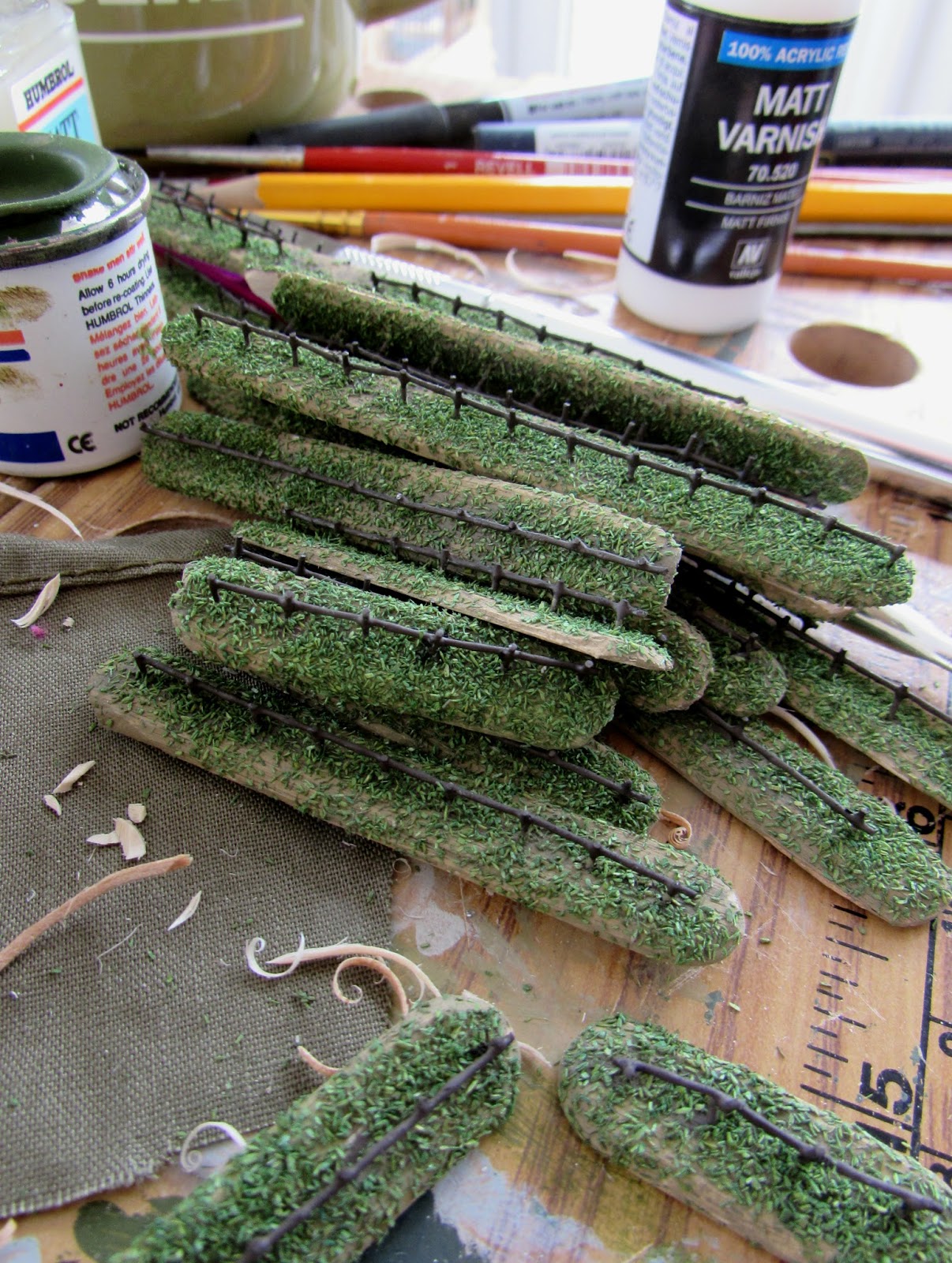
Continuing with terrain features on lolly sticks, today I made rustic fences, hedges and also some painted fences suitable for city boulevards and town squares.

If I never whittle another lolly stick it'll be too soon...

I chamfered and whittled off loads of lolly sticks, some of which had been cut to different lengths for variation this time and trimmed about 1.5m altogether from the aviary wire to see me out with the job in hand. The first lot of fences this time were going to be a more rustic style, bare wood or creosoted finish in Humbrol 98 with the usual Humbrol 29 dark earth and grass mix scatter.

Rustic post & rail fences

The thinnest possible strips were trimmed off green scourer pad for hedges. I used this instead of pipe cleaners as it seems you can only get the chenille variety these days and you can see the twisted wire all too easily compared to the fluffier cotton type that was around 30 years ago. The hedge bases had to be painted brown first as the green pad was open enough to see the ground. 

Hedge clipping

Various Humbrol greens and browns were sloshed on the glued down hedges (which had a good texture but were a horrible blue-green) and different scatters applied until there was a good variation of foliage.

The smartly painted city boulevard central reservations or town square railings differed only in that the grassy area was painted & flocked, then the edge where the stone kerb was going to be had to scraped clean with a scalpel. 

French blue town railings

I've also been experimenting with a fine tweed pattern polyester from charity shop clothes to use as texture for cobbled streets. So far I have sprayed it brown to take the contrast out of the herringbone design and when it is actually in use it will have all sorts of oil pastel shading across the surface. 

Various post & rail fences and hedge

The 'cobbled road' is still too uniform in spite of the amount of spray paint I put on it so I went over a bit of road gently with light yellow ochre and light red-brown oil pastels sideways on to prevent harsh lines and streaks.

With light yellow ochre and re-brown oil pastels

The texture of the cloth meant that I now got the impression of an even pattern of regularly laid cobblestones but without really seeing that it is actually out of scale and herringbone all over.

Tuesday, 1 March 2016

Post & Rail Fences

I'd been thinking about this since we knocked up an aviary in the garden.

Put simply, one strand from fine aviary mesh is trimmed to the length of a lolly stick (which had the edges chamfered off) and hammered gently into place. I used a small cabinetmaking hammer for this. The base is then painted or flocked as required.


I did this first batch in white for use on well-to-do farmsteads; the next batch will be in a more rustic plain wood finish. I am not going to need that many of them as I doubt they will even afford soft cover let alone incur a movement penalty and are just there for a bit of eye-candy.

Monday, 29 February 2016

Carving Hills

So after yesterday's success with colouring the gaming cloth it is time to start carving up foam for under-cloth hills.

Originally scrounged off a neighbour, the stuff has been hanging around for ages. My brother-in-law is having one sheet for his model railway.
Cut down the middle I now have several sections approximately 36mm thick which will be plenty thick enough for the majority of undulating agricultural land. I might save some of the original thickness bits for escarpments, for example, when recreating the town of Cassel.


I used a steak knife to cut the foam to size, going about a centimetre deep to start the cut off, then hacking all the way through. The shallow initial cut meant that the foam didn't split in the wrong direction and the thinness of the blade helped cutting round corners .A carving knife had a whippy enough blade to enable distorting it whilst sawing to scoop sections out or for shaving layers off.


I now have more than enough to cover two pasting tables placed side by side although a lot of the time the terrain will be fairly flat, completely flat (in places) or only slightly undulating. The river sections shown will probably only be used for special scenarios requiring a deeply cut valley (for example, crossing The Meuse or the attack on Fort Eben Emael)


The new gaming cloth on the table shown above. Just add trees, fields, houses, tracks and rivers. With all the hill sections used the landscape is probably rugged enough to recreate the Ardennes sector. May have to make/acquire some thinner contours.